‘It was the best of times, it was the worst of times, it was the age of wisdom, it was the age of foolishness, it was the season of Light, it was the season of Darkness, …it was the spring of hope, it was the winter of despair, we had everything before us, we had nothing before us.‘
This abridged version of Dickens’ famous opening sentence to the Tale of Two Cities feels like it could equally be applied to the biodiversity and climate crisis, perhaps even through the prism of two UK breeding harrier species: the hen harrier and marsh harrier, two species I’ve recently had the good fortune to watch on their breeding grounds.
A visit to Langholm – a southern Scottish ‘Muckle Toon’ – just before Easter to see my dad meant I could watch ‘skydancers’ as the sun rose above the wide vistas of open upland moor. Males gracefully passed females food, and then glided off over tall dark heather swathes. Is any bird a better demonstration of the exquisite combination of grey, white, and black of the male hen harrier?
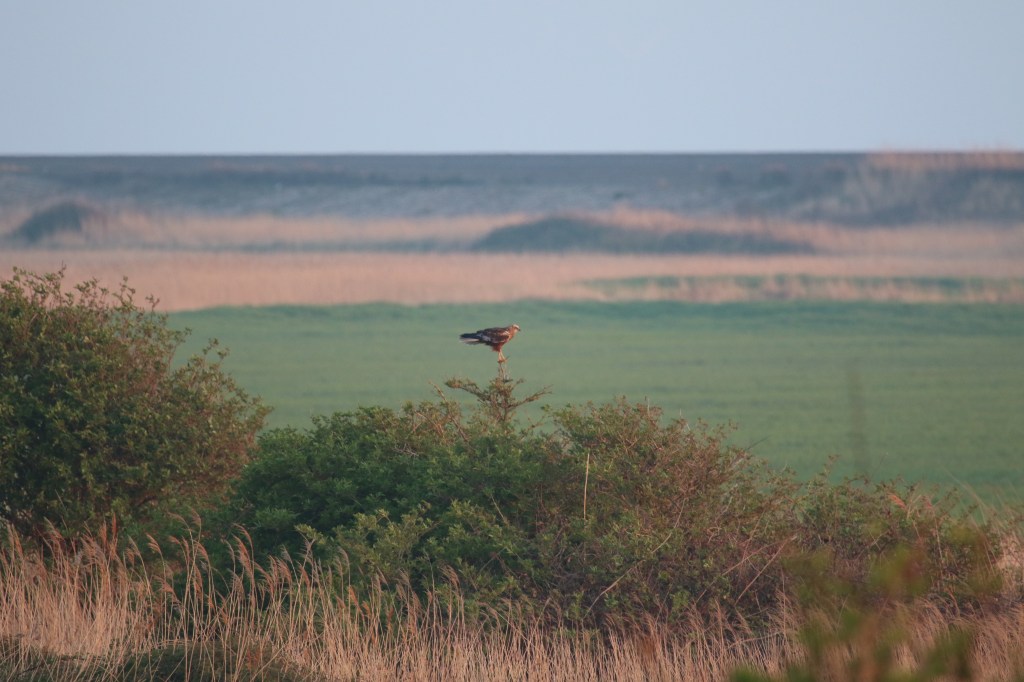
Just a few days later, as the sun rose behind wetland, field and tree, I watched their larger relatives glide over golden reed, having woken from their night-time slumber in Kentish lowland wetland. This time, my mind wandered back to the southern Scottish uplands, wondering why their stories felt so different. Was my feeling correct? Were their stories so different?
At first the story of the hen harrier is closer to that of the marsh harrier than I realised.
Hen harrier was lost from mainland Britain by the end of the 19th century, with only small populations hanging on in the Hebrides and Orkney. Populations in Northern England recovered during the 1970s and 1980s. A survey of Hen Harriers in Scotland in 1988–89 estimated the population at between 408 and 594 breeding pairs (Bibby & Etheridge 1993, in Hayhow et al., 2013). The number of reported breeding pairs of hen harrier in 2018 was between 236 and 387 pairs (Eaton et al., 2018), although the UK and Isle of Man estimate was 575 territorial pairs (Wooten et al., 2018).
What happens when you compare this with marsh harrier? This fared even worse initially and became extinct as a British breeding species in 1899 (Underhill-Day, 1998). Excluding three isolated attempts, recolonisation occurred from 1927 onwards, although none ventured outside of Norfolk to breed until 1945. From a 1958 peak of 15 nests, it reduced to one pair in 1971. Yet by 1995 there were approximately 148 breeding males and 156 breeding females rearing 350 young (Underhill-Day, 1998). The 2018 UK RBBP report recorded 344-423 breeding females/pairs.
This feels, and arguably is, a conservation success story based on science, policy (e.g., banning the use of egg thinning of organochlorine pesticides such as DDT) and habitat creation. The hen harrier does not feel like a modern conservation success story, however. Why?
A quick scan of the 2018 report on the rare breeding birds in the UK report provides the answer. It says… “ a study by Murgatroyd et al. (2019) found that 42 of 58 (72%) Hen Harriers satellite-tagged before fledging in northern England, southern Scotland and the Isle of Man were thought likely to have been killed illegally. They concluded that illegal killing was responsible for a first-year survival rate less than half that in other populations studied, and that the greater the proportion of a bird’s tag-fixes that came from grouse moors, the more likely it was to die or disappear there.” Their declining population and the stark challenges their populations face is captured by their Red UK Conservation Status. The conservation status of Marsh Harrier is a more positive, but not out of the woods, Amber.
Perhaps we can learn from the story of the marsh harrier? Through the application of ‘conservation wisdom’ we created a season of light and a spring of hope for Europe’s largest harrier. If we can do this for one species, why can’t we turn the tide of winter despair so often associated with the contemporary conservation challenges for the hen harrier?
If action leads to hope, then I would encourage you to donate to the Langholm Moor Second-Stage Community Buyout – just go to https://www.langholminitiative.org.uk and from there you can go to their GoFundMe site.

References
Eaton, M & Holling, M. (2018). Rare breeding birds in the UK in 2018. British Birds, 113, 737-791. Available at: https://rbbp.org.uk/annual-reports
Hayhow, D.B., Eaton M.A., Bladwell, S., Etheridge, B., Ewing, S.R., Ruddock, M., Saunders, R., Sharpe, C., Sim, I.M.W., & Stevenson, A. (2010)The status of the Hen Harrier, Circus cyaneus, in the UK and Isle of Man in 2010. Bird Study, 60, 446-458. https://www.researchgate.net/publication/259639382_The_status_of_the_Hen_Harrier_Circus_cyaneus_in_the_UK_and_Isle_of_Man_in_2010
Murgatroyd, M., Redpath, S. M., Murphy, S. G., Douglas, D. J. T., Saunders, R., & Amar, A. 2019. Patterns of satellite tagged Hen Harrier disappearances suggest widespread illegal killing on British grouse moors. Nat. Comm. 10: 1094. https://doi.org/10.1038/s41467-019-09044-w
Underhill-Day, J. (1998). Breeding Marsh Harriers in the United Kingdom, 1983-95. British Birds, 91, 210-218. Available at: https://britishbirds.co.uk/wp-content/uploads/article_files/V91/V91_N06/V91_N06_P210_218_A058.pdf
Wotton, S. R., Bladwell, S., Mattingley, W., Morris, N.G., Raw, D., Ruddock, M., Stevenson, A., & Easton, M.A. (2018). Status of the Hen Harrier Circus cyaneus in the UK and Isle of Man in 2016. Bird Study, 65, 145-160. https://www.tandfonline.com/doi/full/10.1080/00063657.2018.1476462
 Dr Dave's Birding Blog